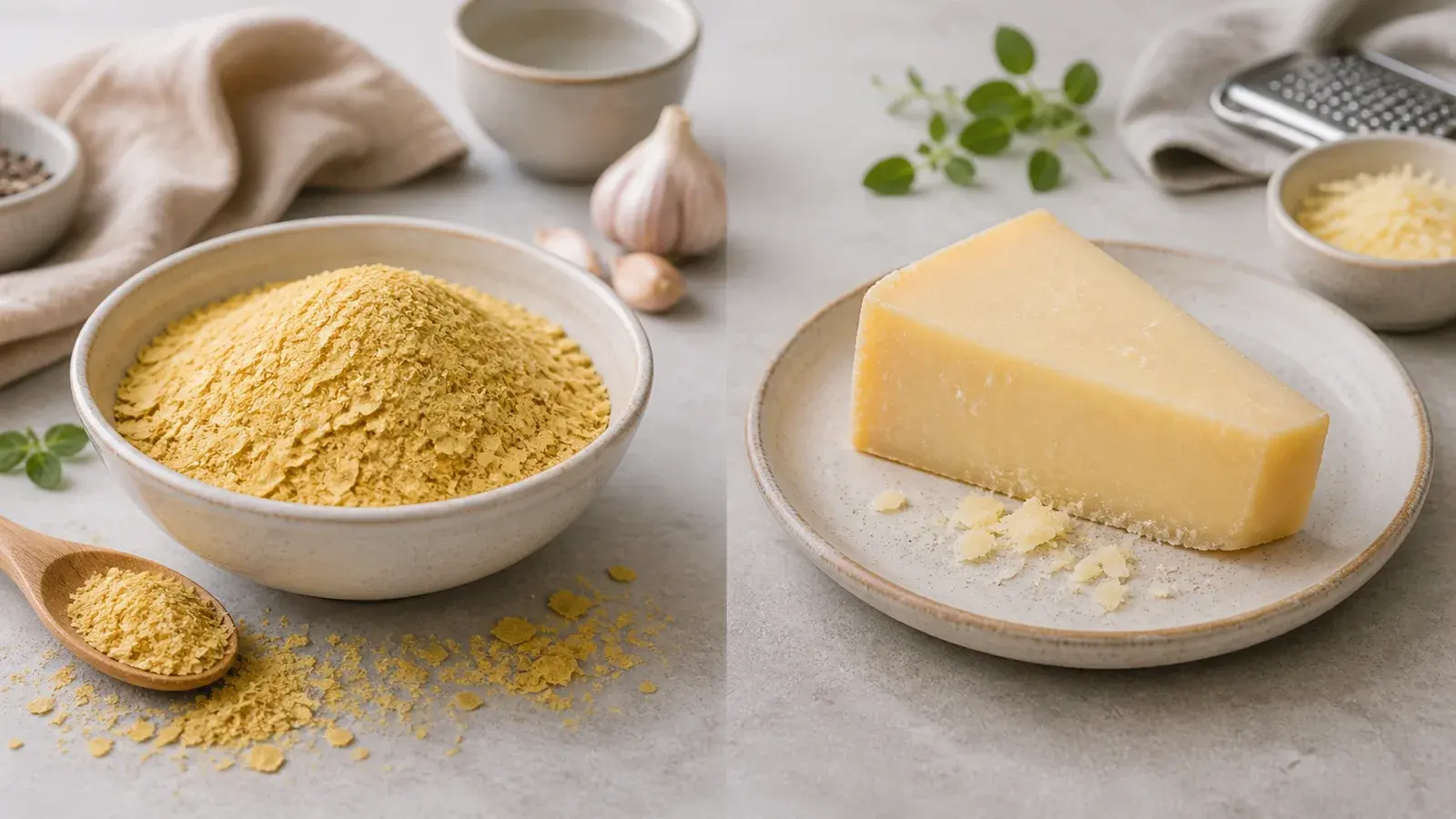
nutritional yeast vs cheese dairy free
Nutritional Yeast vs Cheese: Does It Really Work as a Substitute?
Nutritional yeast vs cheese — does nooch really replace cheese? Honest comparison of flavor, nutrition, melting, and best uses for dairy-free cooking.
Nutritional yeast — affectionately nicknamed "nooch" — has become a staple in dairy-free and vegan kitchens worldwide. But the question most people want answered honestly: does it actually taste like cheese, or is it wishful thinking? The answer depends on what you're trying to achieve. Nutritional yeast is a genuinely useful ingredient, but it's not a perfect cheese replacement for every application.
Quick Comparison
| Property | Nutritional Yeast | Cheese (cheddar example) |
|---|---|---|
| Dairy-free | Yes | No |
| Gluten-free | Usually (check label) | Yes |
| Flavor | Savory, umami, nutty, "cheesy" | Rich, salty, creamy, tangy |
| Melts | No | Yes |
| Protein per 2 tbsp | ~8g | ~7g (cheddar) |
| B12 (if fortified) | Excellent source | Present but lower |
| Best use | Sauces, toppings, popcorn | Melted dishes, slices, boards |
What Is Nutritional Yeast?
Nutritional yeast is deactivated *Saccharomyces cerevisiae* yeast — the same species used in bread and beer, but grown specifically for food, then harvested, heated to deactivate it, and dried into golden flakes or a fine powder. The deactivation process means it has no leavening power.
What it does have is an intensely savory, umami-rich flavor profile that owes itself to glutamic acid (a naturally occurring amino acid, not to be confused with MSG) and a range of other flavor compounds developed during the growing and drying process. Many people genuinely experience the flavor as "cheesy" — particularly parmesan-like or aged cheese adjacent.
Nutritional yeast is also a nutritional standout: it's one of the few plant-based complete proteins, and fortified versions contain significant amounts of B vitamins, including B12 — a nutrient commonly lacking in vegan diets.
Popular brands: Bragg Nutritional Yeast, Bob's Red Mill Nutritional Yeast, Anthony's Premium Nutritional Yeast, Frontier Co-op
What Does It Taste Like?
The honest answer: nutritional yeast tastes like nutritional yeast. It has a savory, slightly nutty, umami-forward flavor with distinct "cheesy" notes — especially when used generously or in combination with other umami-rich ingredients like garlic, lemon juice, and miso.
It does not taste exactly like any specific cheese. It lacks the fat, creaminess, sharpness, and tang of real cheese. However, in cooked applications — blended into a sauce, stirred into mashed vegetables, or dusted over pasta — the gap between "nooch" and cheese is much narrower than it seems raw off the spoon.
Where Nutritional Yeast Shines
Sauces and dips: Blended with soaked cashews, potato and carrot, or white beans, nutritional yeast makes remarkably convincing dairy-free "cheese" sauces for mac and cheese, nachos, and baked potatoes.
Pasta topping: Sprinkled over pasta like parmesan, it adds a savory, nutty kick — particularly effective with olive oil-based pasta dishes.
Popcorn: One of the best uses. Tossed with popcorn, olive oil, and salt, it creates an addictive "cheesy" coating.
Scrambled tofu: Adds a cheesy, savory note that elevates scrambled tofu significantly.
Pesto: Replace half the parmesan with nutritional yeast for a vegan pesto that tastes genuinely satisfying.
Typical quantities: Start with 2–4 tablespoons per recipe. In sauces, some recipes use up to ½ cup.
Where It Doesn't Work
- Melted cheese: Nutritional yeast doesn't melt. It won't give you the stretchy, gooey result of melted mozzarella on a pizza or grilled cheese. For that, use dairy-free cheese products specifically designed to melt (Violife, Miyoko's).
- Fresh cheese texture: It has no ability to replicate the crumbly texture of feta or the creaminess of brie.
- Cold applications: On a cheese board or in a cold sandwich, nutritional yeast doesn't translate well. Its flavor is much more effective when cooked or blended.
⚠️ Safety Notes for Celiacs and Allergy Sufferers
- Gluten: Nutritional yeast is naturally gluten-free as a fermented yeast product. However, some brands add flavorings or are processed in facilities with gluten-containing products. Always check for a certified gluten-free label — Bob's Red Mill and Bragg both offer certified GF options.
- Yeast sensitivity: Some people with Crohn's disease, IBD, or certain autoimmune conditions are advised to avoid yeast products. Consult your doctor or dietitian if this applies to you.
- Histamine: Nutritional yeast is a fermented food and is high in histamine. Those following a low-histamine diet should avoid or minimize it.
- Soy-free: Most nutritional yeast is soy-free, but check labels on flavored varieties.
- Nutritional yeast is free from dairy, eggs, nuts, and gluten (when certified GF), making it broadly compatible with most common dietary restrictions.
Where to Buy
- Amazon US: Shop nutritional yeast on Amazon
- Amazon UK: Shop nutritional yeast on Amazon UK
- iHerb: Browse nutritional yeast on iHerb
Conclusion
Nutritional yeast is not a perfect 1:1 cheese substitute — it can't melt, it lacks fat and tang, and raw off a spoon it tastes nothing like a slice of cheddar. But used smartly in cooked sauces, pasta dishes, dips, and as a topping, it genuinely delivers savory, satisfying, cheese-adjacent flavor. For dairy-free households, it deserves a permanent place in the pantry — especially for making mac-and-cheese-style sauces and adding depth to everyday cooking.
Frequently Asked Questions
Q: Does nutritional yeast actually taste like cheese? It has cheesy, savory, umami notes — particularly similar to parmesan — but it doesn't taste exactly like any specific cheese. Most people find it convincingly "cheesy" when cooked into sauces or sprinkled over hot pasta. Tasted raw on its own, it tastes like nutritional yeast: savory, nutty, and slightly fermented.
Q: Is nutritional yeast the same as brewer's yeast? No. Both are deactivated forms of *Saccharomyces cerevisiae*, but they're grown and processed differently. Nutritional yeast is specifically cultivated to be a flavorful food supplement with a good nutritional profile. Brewer's yeast is a byproduct of beer production; it's more bitter and less pleasant to eat as a food topping.
Q: Can I use nutritional yeast if I have celiac disease? Yes, as long as you choose a certified gluten-free product. Nutritional yeast itself is gluten-free by nature, but cross-contamination during processing is possible. Bob's Red Mill, Bragg, and Anthony's all offer certified GF options.
Q: How much nutritional yeast should I use to replace parmesan? As a rough guide, use 2 tablespoons of nutritional yeast to replace about 2 tablespoons of grated parmesan. In cooked sauces, you may want to increase to 3–4 tablespoons to achieve a similar depth of savory flavor. Taste as you go — it's easy to add more, harder to dial it back.
Q: Is nutritional yeast safe to eat every day? For most people, yes. It's a highly nutritious food. However, it is high in purines, so people with gout or uric acid issues should moderate intake. It's also high in histamine, so those following a low-histamine diet should limit or avoid it. If you're unsure, check with your dietitian.