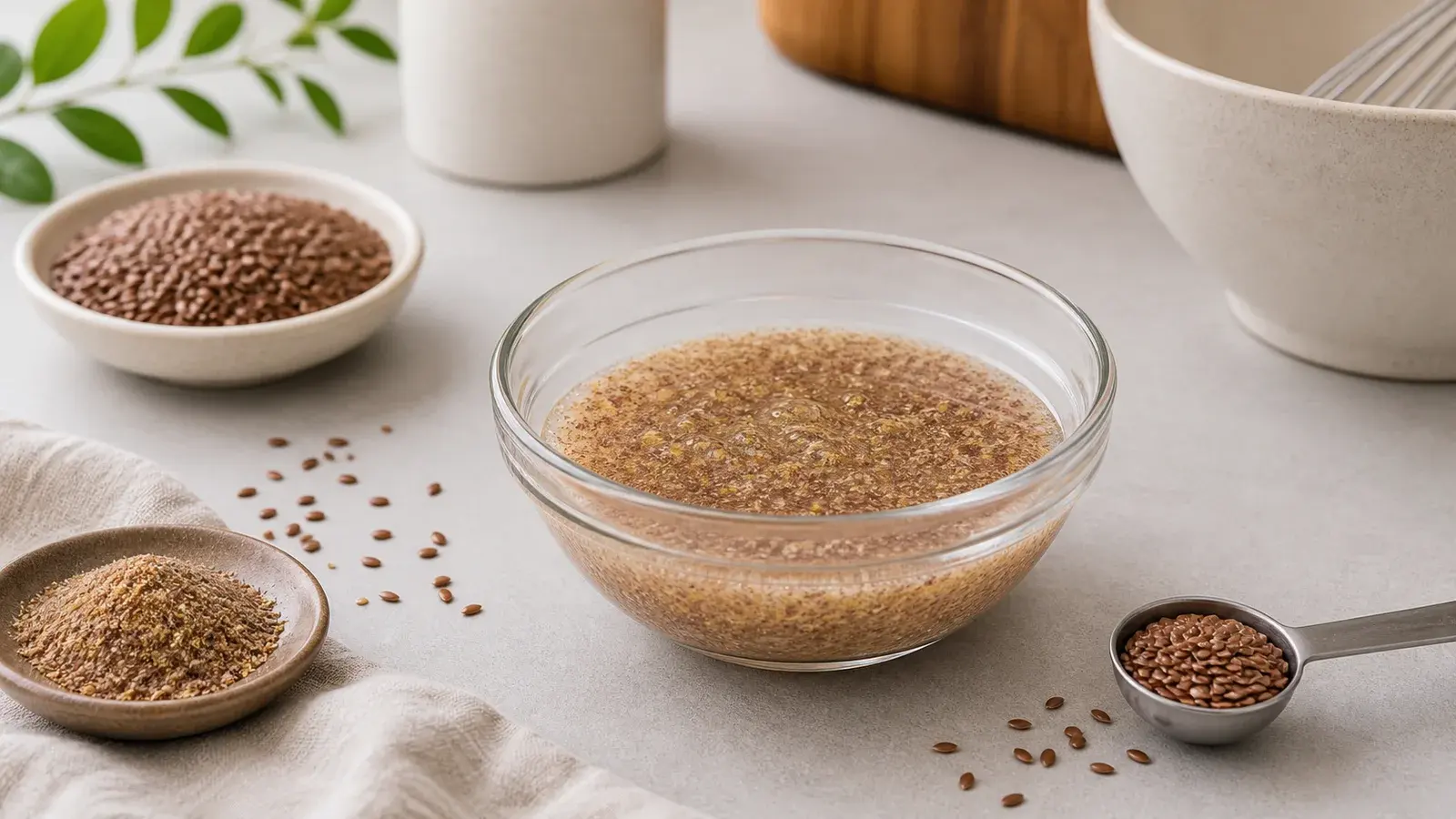
flax egg substitute
Flax Egg
Flaxseed (Linum usitatissimum) is an ancient crop cultivated for both its fiber and its oil-rich seeds. Ground flaxseed (also called milled flaxseed or flax meal) has a high concentration of soluble mucilage fiber — the same gel-forming fiber that makes psyllium husk so effective. When ground flaxseed is mixed with water, the mucilage quickly absorbs the water and swells into a thick, viscous gel that closely resembles the texture of an egg when used in baking. The flax egg does not add lift or leavening — it does not replicate the aerating property of whipped eggs or egg whites. Its primary function is binding: it holds ingredients together, adds moisture, and provides a slight structure. For recipes where egg is primarily a binder and moisture source (muffins, cookies, quick breads, veggie burgers), a flax egg is an excellent substitute. For recipes where eggs provide significant lift (soufflés, light cakes), a flax egg is less effective. Flaxseed is also nutritionally impressive: rich in alpha-linolenic acid (ALA, a plant-based omega-3 fatty acid), lignans (phytoestrogens with antioxidant activity), and soluble fiber. Adding flax eggs to baked goods inadvertently boosts their nutritional profile.
What is it?
A flax egg is made by combining 1 tablespoon of ground (milled) flaxseed with 3 tablespoons of water. After 5–10 minutes of resting, the mixture thickens into a gel approximately the consistency of a beaten egg. This gel is then added to the recipe in place of one whole egg. Key notes: - Ground vs. whole: Whole flaxseeds will not form a gel — they must be ground for the mucilage to be released. Use pre-ground flaxseed (flax meal) or grind whole seeds in a blender. - Golden vs. brown flax: Both work equally well. Golden flaxseed is slightly milder in flavor and lighter in color; brown flaxseed is more common and less expensive. Use whichever you have. - Flavor: Ground flaxseed adds a mild, nutty flavor that is generally unnoticeable in recipes with strong flavors but detectable in very plain baked goods.
How to use
Basic flax egg recipe: - 1 tablespoon ground flaxseed - 3 tablespoons water - Mix together and rest for 5–10 minutes until thickened. Use in place of 1 egg. Applications and success rate: - Muffins and quick breads: Excellent — the flax egg binds and moistens perfectly. ✓✓✓ - Cookies: Very good — produces a slightly denser, chewier cookie. ✓✓✓ - Pancakes: Good — adds density; works best blended with a little baking powder. ✓✓ - Dense cakes (banana bread, carrot cake): Excellent. ✓✓✓ - Veggie burgers and fritters: Outstanding binding. ✓✓✓ - Light sponge cakes: Less effective — eggs provide crucial lift that flax cannot replicate. ✗ - Custards, ice cream, or emulsified sauces: Not suitable. ✗ Multiple flax eggs: A recipe calling for 2–3 eggs can use flax eggs, but results become denser. Consider supplementing with a small amount of baking powder for additional lift.
Substitutes
| Substitute | Ratio | Notes |
|---|---|---|
| Chia egg | 1 tbsp chia + 3 tbsp water | Very similar; slightly more neutral flavor; gels faster |
| Psyllium egg | 1 tsp psyllium powder + 3 tbsp water | Stronger binder; excellent for breads |
| Aquafaba | 3 tbsp per egg | More neutral flavor; also adds moisture |
| Commercial egg replacer (GF) | Per package | Varies; some add lift via leavening |
| Unsweetened applesauce | 3 tbsp per egg | Adds moisture and sweetness; no binding |
Safety notes
⚠️ Flaxseed and Hormonal Sensitivity: Flaxseeds are high in lignans — phytoestrogenic compounds that can mimic estrogen at very high intakes. For normal baking quantities (1–2 tablespoons of ground flax per recipe), this is not a concern for healthy adults. However, individuals with hormone-sensitive conditions (such as certain breast cancers, endometrial cancers, or PCOS treated with hormone therapy) should discuss flaxseed consumption with their oncologist or endocrinologist. ⚠️ Blood-Thinning Properties: Flaxseed's high ALA (omega-3) content may have mild blood-thinning effects. People on anticoagulant medications (warfarin, heparin, aspirin therapy) should check with their physician before consuming large quantities of flaxseed regularly. ⚠️ Cross-contamination: Ground flaxseed is naturally gluten-free, but some milling facilities process it alongside wheat. Purchase certified gluten-free ground flaxseed for celiac-safe use. ⚠️ Rancidity: Ground flaxseed (flax meal) is very high in oil and goes rancid rapidly at room temperature. Rancid flax has a bitter, paint-like smell and should be discarded — rancid oils are harmful to health. Always refrigerate or freeze ground flaxseed after opening. ⚠️ Whole vs. Ground: Whole flaxseeds pass through the digestive system largely undigested and provide fewer nutritional benefits than ground flaxseed. Always use ground (milled) flaxseed in flax eggs, both for the gelling function and for optimal nutrient absorption.
Where to buy
- Health food stores: Whole Foods Market, Sprouts, Natural Grocers (US); Holland & Barrett, Waitrose (UK) - Mainstream grocery: Ground flaxseed (flax meal) is widely available in large supermarkets - Online (US): iHerb, Amazon, Bob's Red Mill (Golden Flaxseed Meal), Anthony's Goods - Online (UK): Amazon UK, Linwoods (popular UK brand of milled flaxseed), Holland & Barrett Bob's Red Mill and Spectrum Organics (US), Linwoods (UK) are popular certified GF options.
Some product links may be affiliate links when a valid partner ID is configured. Always verify ingredients and labels before buying.
Storage
Ground flaxseed (flax meal): Must be refrigerated or frozen. Refrigerate after opening for up to 3 months. Freeze for up to 12 months. The high oil content causes rapid oxidation at room temperature — this is the most important storage note for this ingredient. Whole flaxseeds: More shelf-stable. Store in an airtight container in a cool, dark place for up to 12 months at room temperature, or freeze for extended storage. Grind as needed for freshest results.
FAQ
Does a flax egg taste like egg?
No — a flax egg does not taste like egg. It adds a mild, nutty flavor. In most baked goods with other strong flavors (banana, chocolate, spices, citrus), this is undetectable. In very plain baked goods, a subtle nuttiness may be noticeable. Golden flaxseed is slightly milder than brown.
Can I use a flax egg to make scrambled eggs?
No. A flax egg is a functional substitute for eggs in baking — it provides binding and moisture. It cannot replicate the protein-coagulating, scrambling, poaching, or omelet-making properties of real eggs. For egg-like scrambles, use silken tofu or a commercial egg substitute designed for that purpose.
How many flax eggs can I substitute in one recipe?
In most recipes, 1–2 flax eggs work very well. Substituting 3 or more eggs with flax eggs can result in significantly denser, moister baked goods. For high-egg recipes requiring 3+ eggs, consider using a combination of flax eggs plus a small amount of extra baking powder for lift, or use a different egg substitute (like aquafaba for the structural eggs) alongside the flax eggs.
Why is my flax egg not thickening?
The most common reason is using whole flaxseeds instead of ground flaxseed — whole seeds cannot release their mucilage effectively. Ensure you are using ground or milled flaxseed, allow the full 5–10 minutes to rest, and use cold or room-temperature water (hot water can prevent proper gel formation in some cases).
Is flaxseed gluten-free?
Yes — flaxseeds are naturally gluten-free. However, cross-contamination during growing, transport, or milling is a documented risk. For celiac-safe baking, purchase certified gluten-free ground flaxseed from a verified GF facility. Bob's Red Mill, for example, produces certified GF flaxseed meal in dedicated GF facilities.