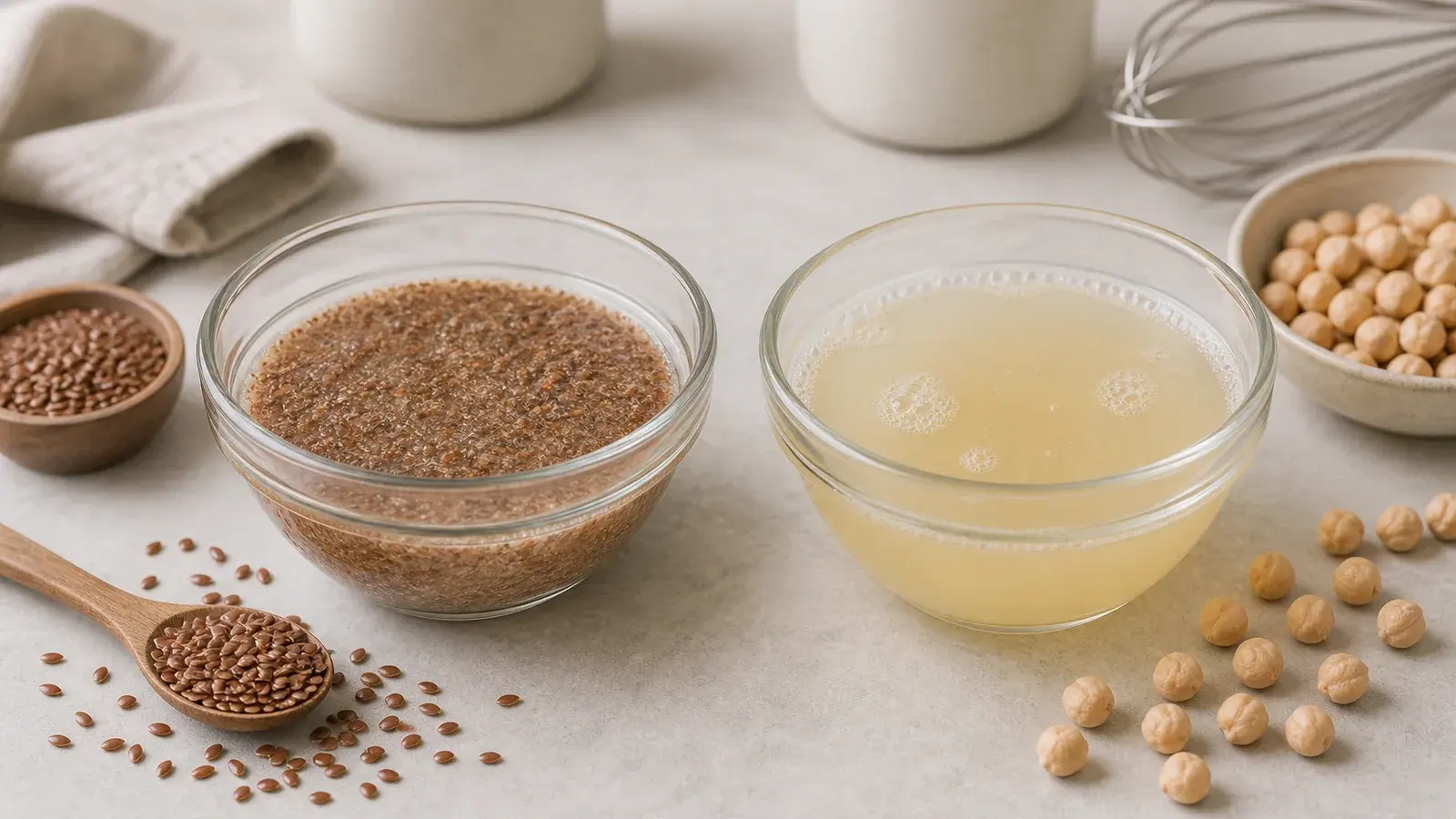
flax egg vs aquafaba egg substitute
Flax Egg vs Aquafaba: Which Egg Substitute Works Better?
Flax egg vs aquafaba — compare these two popular vegan egg substitutes for baking. Ratios, best uses, textures, and allergy safety notes for egg-free cooking.
Eggs do a lot of work in baking — they bind ingredients, add moisture, provide structure, and in some recipes, create lift through aeration. When you're baking egg-free (whether due to an egg allergy, veganism, or just an empty fridge), the right substitute depends on exactly which of those functions the egg was serving. Flax egg and aquafaba are two of the most popular plant-based options, but they excel in very different situations.
Quick Comparison
| Property | Flax Egg | Aquafaba |
|---|---|---|
| Made from | Ground flaxseed + water | Liquid from canned chickpeas |
| Replaces | 1 whole egg (binding) | 1 whole egg or egg white |
| Best for | Muffins, pancakes, dense cookies | Meringues, mousses, light cakes |
| Can whip to stiff peaks | No | Yes |
| Flavor | Mild nutty | Neutral (slight bean note) |
| Allergens | None common | Soy/legume (chickpea) |
What Is a Flax Egg?
A flax egg is a gel made by combining ground flaxseed (flax meal) with water and allowing it to rest for 5–10 minutes. As the mixture sits, mucilage — a natural gelling fiber in flaxseed — absorbs the water and forms a thick, viscous gel that can bind ingredients together in much the same way a whole egg does.
How to make a flax egg:
- 1 tablespoon ground flaxseed (flax meal)
- 3 tablespoons water
- Mix and rest for 5–10 minutes until gel forms
- Use as a substitute for 1 large egg
The flax egg provides moisture and binding, but it does not create lift or aeration. It is most successful in dense, hearty baked goods where a whole egg was acting primarily as a binder.
Best results with flax egg:
- Banana bread and muffins
- Pancakes and waffles
- Oatmeal cookies and energy bars
- Veggie burgers and patties
- Dense chocolate cake
Less successful:
- Angel food cake or chiffon cake (requires egg foam for structure)
- Delicate sponge cakes
- French macarons
Popular products: Bob's Red Mill Flaxseed Meal, Anthony's Organic Ground Flaxseed
What Is Aquafaba?
Aquafaba is the viscous liquid found in a can of chickpeas (or produced by cooking dried chickpeas). The word comes from the Latin for water (aqua) and bean (faba). During cooking, the chickpeas release proteins and starches into the liquid that give it functional properties remarkably similar to egg whites.
The most remarkable quality of aquafaba is that it can be whipped to stiff peaks — just like egg whites — in about 3–5 minutes with an electric hand mixer or stand mixer. This makes it the only widely available plant-based egg substitute that can create the foam and structure needed for meringues, mousses, and light aerated desserts.
Substitution ratios:
- 3 tablespoons aquafaba = 1 whole egg
- 2 tablespoons aquafaba = 1 egg yolk
- 1.5 tablespoons aquafaba = 1 egg white
Best results with aquafaba:
- Meringues (aquafaba meringue is remarkably stable)
- Chocolate mousse
- Macarons
- Chiffon cake and angel food cake
- Mayonnaise and aioli
- Light, fluffy pancakes
Tip for stability: Add ¼ teaspoon cream of tartar per ½ cup aquafaba before whipping — this stabilizes the foam exactly as it does with egg whites.
When to Use Each
The choice comes down to the egg's role in your recipe:
Choose flax egg when: The egg was binding and adding moisture (muffins, cookies, quick breads, pancakes). It's cost-effective, shelf-stable, and adds a small nutritional boost (omega-3 fatty acids, fiber).
Choose aquafaba when: The egg was providing lift, foam, or structure through aeration (meringues, soufflés, chiffon cakes, mousse). Nothing plant-based whips as well.
For recipes where eggs do both — bind and aerate (like a layer cake) — use aquafaba for the aeration component and consider adding ½ tablespoon of flaxseed meal to the batter for extra binding.
⚠️ Safety Notes for Celiacs and Allergy Sufferers
- Flax egg is free from all major allergens except potentially cross-contamination in facilities that process nuts or wheat. Choose certified GF flaxseed meal if you have celiac disease.
- Aquafaba is derived from chickpeas, which are legumes. People with legume allergies or soy allergies should check with their allergist before using aquafaba. Soy-allergic individuals often (but not always) react to other legumes.
- Canned chickpea brine: Choose certified GF canned chickpeas — some may contain additives or be processed in facilities handling wheat. Brands like Eden Organic specify BPA-free and certified GF.
- Neither substitute contains gluten in its pure form, but always verify manufacturing conditions if you have celiac disease.
- If you are managing a seed allergy, flaxseed is a seed and should be avoided.
Where to Buy
- Amazon US: Shop flaxseed meal for egg-free baking on Amazon
- Amazon UK: Shop flaxseed and egg substitutes on Amazon UK
- iHerb: Browse flaxseed products on iHerb
Conclusion
Neither flax egg nor aquafaba is universally "better" — they solve different problems. Reach for a flax egg in dense, hearty baked goods where binding is the priority. Reach for aquafaba when you need aeration, foam, or lift. Keep both in your pantry: ground flaxseed stores for months in the freezer, and a can of chickpeas is one of the cheapest pantry staples you can buy. Together, they cover nearly every egg-free baking scenario.
Frequently Asked Questions
Q: Can I use aquafaba in any recipe that calls for eggs? Aquafaba works best where eggs provide lift and foam. For purely binding roles (like in a cookie or muffin), it works but a flax egg often produces a better texture. For whole cakes, aquafaba (whipped) combined with a small amount of cornstarch or arrowroot for binding tends to give the best results.
Q: Does aquafaba taste like chickpeas? Aquafaba has a very mild, faintly bean-like flavor that almost entirely disappears during baking or once sweetened. In meringues and chocolate-based desserts, most people cannot detect it at all. For savory applications like vegan mayo, the neutral flavor is an advantage.
Q: Can I make aquafaba from other beans? Yes, the liquid from most canned legumes can be whipped similarly — white bean liquid, cannellini bean liquid, and even black bean aquafaba all work. Chickpea aquafaba is the most reliable and neutral in color. Darker bean liquids will tint your recipe.
Q: How long does a flax egg last? A prepared flax egg (mixed with water) keeps in the refrigerator for up to 1 week. Ground flaxseed meal itself keeps for several months in an airtight container in the freezer — storing it this way prevents the oils from going rancid.
Q: How many flax eggs can I substitute in one recipe? Most recipes accommodate 1–2 flax eggs without significant structural issues. Using 3 or more can result in a gummy or dense texture. For recipes requiring many eggs, aquafaba is usually the better choice, or consider a commercial egg replacer like Bob's Red Mill Egg Replacer which is formulated for higher-volume substitution.