AuthorpashutFree Editorial Team
Last updated2026-05-31
Medical disclaimer
In-depth read: 10–15 minutesThis information is for culinary and general health education only. It is not a diagnosis, treatment plan, personalized medical advice, or a substitute for a physician, allergist, gastroenterologist, registered dietitian, qualified rabbinical authority, or school health plan. For severe allergy, suspected celiac disease, new symptoms, or dietary changes for children, use licensed professional guidance and an individualized emergency plan.
Introduction
Sunflower Seed Butter Substitute Guide is much more than a list of recipes without almonds or peanuts. Nut allergy work starts with precision: peanuts are legumes, tree nuts are a different group, and a person may need to avoid one, both, or only specific nuts. FDA – Food Allergies identifies major food allergens and supports the safety rule that the exact allergen must be named clearly.
For parents and caregivers, the hard part is usually not one cookie recipe. It is the daily system: which chocolate chips are allowed, whether a school accepts homemade snacks, whether a shared jar is safe, and whether a substitute such as sunflower seed butter introduces seed, sesame, soy, dairy, gluten, or facility warnings.
Nut-free cooking works best as a reviewed workflow, not a promise of universal safety. The family needs to understand what nut allergy means, why reactions happen, what symptoms require medical planning, what diagnosis belongs to clinicians, and how all of that becomes shopping, baking, lunchbox, and family-kitchen behavior.
Substitution by function
“Use sunflower seed butter instead” is not enough. A parent needs to know what role peanut butter or almond butter played in the recipe: fat, flavor, binding, spreadability, moisture, or protein. Only then can the substitute be judged.
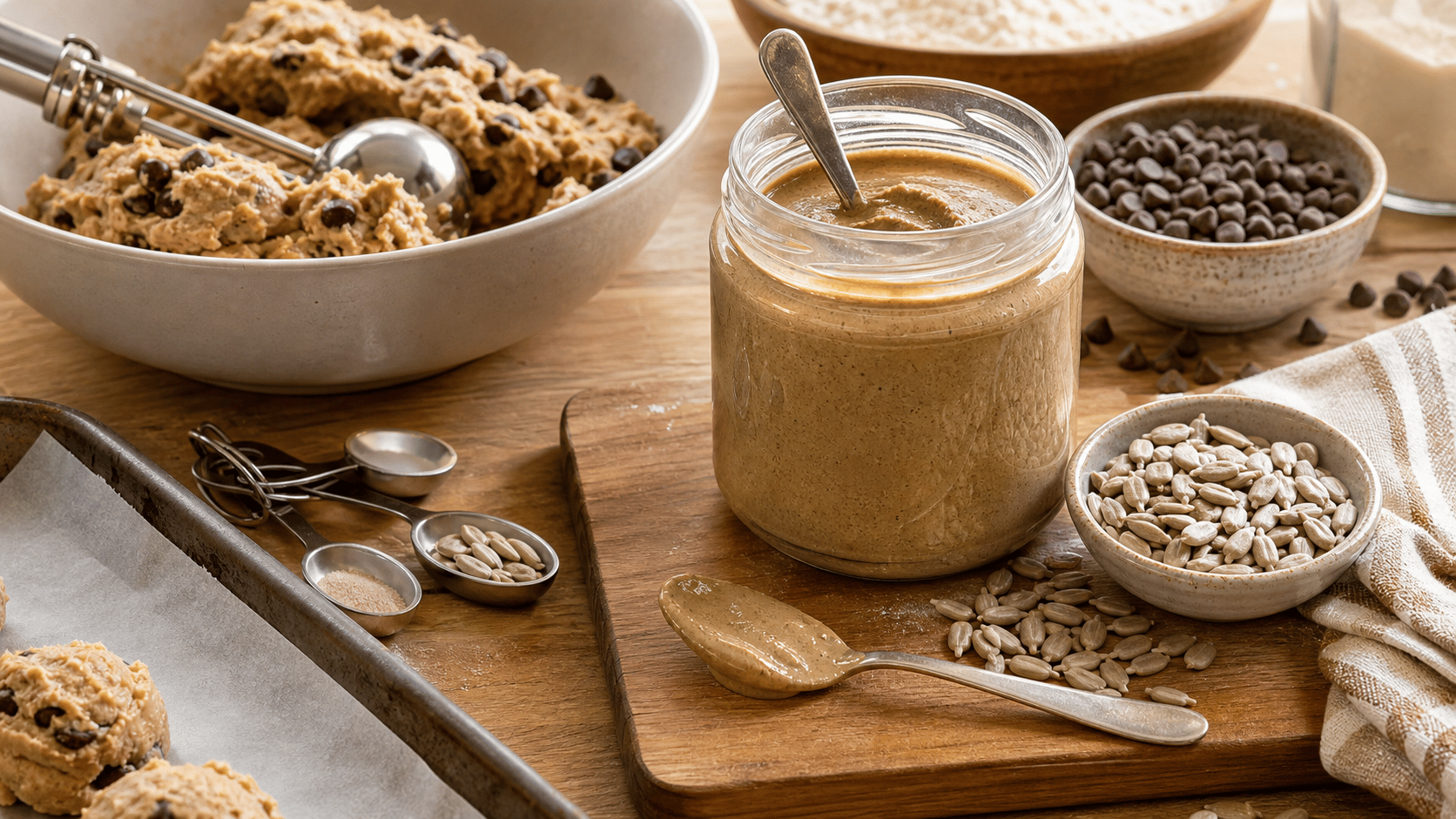
The substitution logic should stay honest. Colorado State University Extension – Ingredient Substitutions supports thinking in terms of ingredient function. Sunflower seed butter can be useful, but it may change color, sweetness, texture, and allergen review because seed and facility statements still matter.
| Recipe role | What sunflower seed butter can do | What to watch |
|---|---|---|
| Binding | Can help cookies and bars hold together. | May need chilling or flour adjustment. |
| Flavor | Adds roasted seed flavor. | May not taste like peanut butter. |
| Allergen review | Avoids peanut/tree nut ingredients. | Still check sesame, soy, gluten, and facility warnings. |
What is it?
A food allergy is an immune response to a food protein. In nut allergy content, precision matters because people often use the word nut loosely. Peanut allergy and tree nut allergy are not identical, and coconut, seeds, legumes, and nut-flavored ingredients can all create confusion in everyday cooking.
A tree nut allergy may involve almonds, walnuts, cashews, pistachios, pecans, hazelnuts, Brazil nuts, or other tree nuts. A peanut allergy involves peanuts. Some families avoid both because of medical guidance, school policy, cross-contact concerns, or individual history. A recipe should never assume that avoiding one group automatically answers the other.
The practical rule is to separate peanut-free, tree-nut-free, and broadly nut-free language. If a recipe uses sunflower seed butter, tahini, soy butter, or oat flour, the recipe still needs new allergy checks for those ingredients.
| Food | Category | Common confusion | Cooking note |
|---|---|---|---|
| Peanut | Legume | Not a tree nut | Peanut-free does not always mean tree-nut-free |
| Almond/walnut/cashew | Tree nuts | Different from peanuts | Name the exact nut avoided |
| Coconut | Botanical and regulatory nuance | May be treated differently by families | Ask the person and check labels |
Why it happens
Nut allergy reactions happen because the immune system identifies a food protein as harmful. The amount, route of exposure, individual sensitivity, coexisting asthma, age, and medical history can all affect risk. A recipe website cannot determine that risk for a user.
Cooking adds another layer because nut proteins may appear directly in ingredients, indirectly in mixed products, or through cross-contact. Chocolate chips, granola, cereal, pastry decorations, flour blends, oils, sauces, and bakery items can all require label review. The ingredient that seems secondary may be the one that changes the whole recipe.
CDC – Food Allergies in Schools is relevant for school contexts because food allergy management depends on planning and communication. A snack is not school-ready just because the recipe avoids peanuts; it must also fit the school policy, classroom plan, and the affected family’s instructions.
How to choose a substitute
Before choosing a substitute, identify what the original ingredient did in the recipe. Was it liquid, fat, binding, lift, browning, creaminess, or flavor? That answer matters more than the name on the package.
At home, the practical method is to run a small test: replace one ingredient at a time, write down the ratio, check the texture after baking or chilling, and only then serve it to guests or send it to school.
Every substitute also needs its own allergen review. Almond milk does not work for nut-free cooking, tahini does not work for sesame-free cooking, soy milk does not work for soy-free cooking, and oats need the right label when cooking for celiac needs.
Checklist
- ✓ Identify the original ingredient’s job before replacing it.
- ✓ Start with a small batch or half recipe.
- ✓ Read the substitute’s label like any other ingredient.
- ✓ Write down what worked so the family can repeat it.
When a substitute is ready to use
A good substitution decision starts with one question: what happens if it fails? If it is a family cookie, you can test and adjust. If it is dessert for an allergic guest or a school snack, choose a substitute that is familiar, labeled, and easier to verify.
Do not rely only on a 1:1 ratio. Check taste, color, moisture, chilling, bake time, and whether the recipe needs another binder. Sometimes the right substitute is not one ingredient but a combination: the right flour, the right fat, and the right binder.
A useful decision leaves a record: which brand was used, what ratio worked, what changed in texture, and whether the result fits the same need again.
| Question | If yes | If no |
|---|---|---|
| Does the substitute do the same job? | Move to allergen review | Choose by a different recipe function |
| Is the label clear? | Consider using it | Choose a clearer product |
| Is it for school or a guest? | Check policy and keep packaging | Run a small home test first |
Everyday life implications
Everyday nut-free life is full of small decisions. Which spread is kept in the house? Are there separate jars for jam and chocolate spread? Are bulk-bin ingredients avoided? Are birthday cupcakes allowed at school? Are relatives comfortable reading labels before cooking for the child?
The most reliable systems are boring in the best way: labeled storage, clean utensils, ingredient photos, saved product lists, clear lunchbox rules, and a habit of rechecking labels when a package changes. The goal is not anxiety; it is repeatable confidence.
Restaurants and bakeries need special caution because nuts are common in desserts, pastry kitchens, pesto, salads, sauces, toppings, and decorative garnishes. Asking only whether a dish contains nuts may miss shared equipment or supplier warnings.
Checklist
- ✓ Define whether the recipe is peanut-free, tree-nut-free, or both.
- ✓ Check chocolate, flours, spreads, cereals, toppings, and decorations.
- ✓ Avoid shared jars and bulk bins for allergy-sensitive cooking.
- ✓ Keep school snack packaging or ingredient notes available.
- ✓ Use calm, specific wording with relatives, teachers, and hosts.
| Situation | Risk | Recommended action |
|---|---|---|
| School snack | Shared classroom exposure | Use school policy and labeled packaging |
| Birthday cake | Nut flours and toppings | Ask bakery about ingredients and facility |
| Shared pantry | Nut dust and open bags | Separate sealed bins and scoops |
Real-life scenarios
These scenarios turn information into decisions. Instead of memorizing many rules, check what is actually about to happen: shopping, school, restaurant dining, a holiday meal, hosting, or a family dinner.
When there is uncertainty, choose a simple action: a clearer product, a simpler dish, a cleaner tool, or one more precise question. That reduces mistakes without turning every meal into a stressful discussion.
Checklist
- ✓ Save label photos for regular products.
- ✓ Prepare a backup for school, trips, or holidays.
- ✓ Ask restaurants about sauce, oil, and prep tools.
- ✓ Serve restricted dishes first with clean utensils.
| Scenario | What can go wrong | What to do |
|---|---|---|
| Family meal | Spoons move between dishes or crumbs enter a jar | Serve the restricted dish first with a separate utensil |
| School | Homemade snack conflicts with policy or lacks ingredients | Keep a backup snack with a clear label |
| Shopping | Front label sounds helpful but the full label is complex | Read ingredients, allergen statements, and warnings before buying |
| Restaurant | Sauce, fryer oil, or shared surfaces are not checked | Ask about preparation, not only the dish name |
| Holiday | Many dishes and serving tools get mixed | Label the adapted dish and keep it covered until serving |
| Hosting guests | Host guesses from broad terms | Send the exact ingredients to avoid before shopping begins |
Cooking implications
Colorado State University Extension – Ingredient Substitutions helps with substitution thinking because good substitutions are based on function. Nut butter may provide fat, binding, flavor, and moisture. Chopped nuts may provide crunch. Nut flour may provide fat and structure. Replacing all of those with one ingredient rarely works perfectly.
Sunflower seed butter can be useful where peanut butter supplied fat and body, but it may change color, flavor, and sweetness. Oats labeled gluten-free can add texture in some recipes, but they do not work for every celiac household unless the label and personal tolerance fit. Seeds can add crunch, but sesame and seed allergies must be considered.
A professional recipe should say why the substitute is used. It should not simply say swap almond flour for oat flour or peanut butter for sunflower seed butter without explaining texture, moisture, flavor, and allergen consequences.
Do
- ✓ Choose substitutes by function: fat, crunch, structure, moisture, or flavor.
- ✓ Check the substitute for other allergens.
- ✓ Keep packaging when food is going to school.
- ✓ Test texture in small batches before serving to guests.
Don't
- • Do not replace peanuts with almonds in a nut-free context.
- • Do not assume seeds are safe for every person.
- • Do not ignore may-contain or facility warnings.
| Original ingredient | Substitute | Ratio | Texture change | Best for | Not suitable for |
|---|---|---|---|---|---|
| Peanut butter | Sunflower seed butter | 1:1 | Similar thickness | Cookies, sandwiches | Seed allergy without label check |
| Almond flour | Oat flour labeled gluten-free | Start 1:1 by weight | Less fat, drier | Cookies, crumbs | Severe oat/gluten concern |
| Chopped nuts | Toasted seeds | 1:1 | Crunchy | Salads, toppings | Seed allergy |
Common mistakes
The first common mistake is using the word nut-free without defining it. The second is assuming that homemade automatically means safer. Homemade food can be excellent, but it can also carry cross-contact from a cutting board, jar, baking tray, measuring cup, or pantry bin.
The third mistake is trusting the old label. Food manufacturers can change suppliers, recipes, and facility statements. A product that worked last month still needs review when packaging changes. This is especially important for school snacks, where the person eating the food may not be the person who prepared it.
The fourth mistake is making emotional promises. Parents want to be helpful, but “don’t worry, it’s safe” is not a professional standard. Better wording is “I checked these ingredients, used clean tools, and kept the package for review.”
Safety considerations
Safety begins with individual allergy plans. A household should follow medical guidance about avoidance, emergency medication, school forms, and when to call emergency services. Content can educate, but it cannot personalize risk.
Cross-contact can occur when utensils, surfaces, jars, trays, towels, or storage bins touch nut-containing foods. A shared chocolate chip bag from a baking station, a spoon used in peanut butter, or a bakery tray can undermine an otherwise nut-free recipe.
For kosher or pareve contexts, remember that pareve does not mean nut-free. A pareve dessert may contain nuts, peanuts, sesame, soy, gluten, or facility warnings. Allergy-safe and kosher-compatible are different review layers.
| Kitchen item | Risk level | Why | Recommended action |
|---|---|---|---|
| Nut butter jar | High | Shared knives carry residue | Use a separate jar |
| Baking tray | Medium | Nut crumbs can stick | Line or wash thoroughly |
| Bulk bins | High | Scoops can move allergens | Avoid for allergy cooking |
Troubleshooting
If a nut-free cookie spreads too much, the substitute may have different fat and water content than peanut butter or almond flour. Chill the dough, reduce liquid slightly, or use a more structured flour blend. If the cookie is dry, the recipe may need more fat or a softer sugar balance.
If the snack cannot go to school, the issue may not be the recipe. It may be missing packaging, school policy, may-contain warnings, unclear ingredients, or a classroom restriction against all homemade food.
If a family disagrees about whether tree nuts are allowed, pause the recipe decision. The medical plan and school rules should decide the food category before the cooking begins.
| Problem | Likely issue | Next step |
|---|---|---|
| Cookie texture changed | Substitute behaves differently | Adjust fat, liquid, chilling, or flour blend. |
| School rejects snack | Policy or label issue | Use packaged option or provide ingredient information. |
| Family confusion | Peanut/tree nut categories unclear | Clarify the allergy plan before cooking. |
FAQ
Can sunflower seed butter replace peanut butter?
Often it can replace peanut butter by volume in simple cookies or bars, but flavor, color, sweetness, and allergen profile still need review.
Is sunflower seed butter safe for everyone with nut allergy?
No. It is not a tree nut or peanut, but seed allergy, sesame concerns, product labels, and cross-contact still matter.
Why can sunflower seed butter turn baked goods green?
Some sunflower seed baked goods can change color because of natural reactions with leavening. The color change is a quality issue, not a safety claim.
Can it go to school?
Only if the school policy, product label, and household preparation process fit the child’s environment. Do not rely on the ingredient name alone.