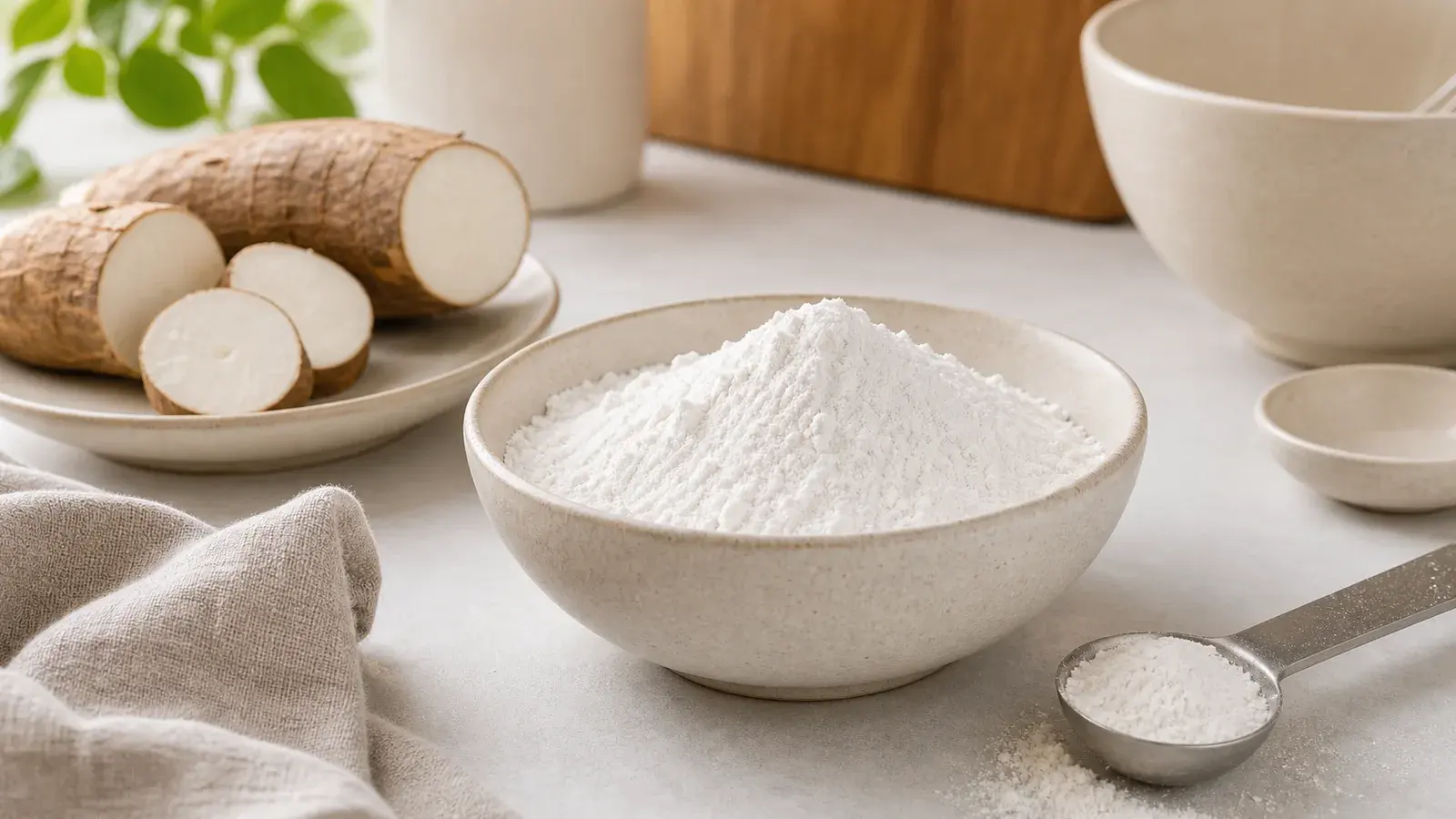
cassava flour gluten-free
Cassava Flour
Cassava (Manihot esculenta) is a starchy root vegetable native to South America, now widely cultivated across tropical regions of Latin America, Africa, and Asia. It is a dietary staple for hundreds of millions of people worldwide. The flour made from it should not be confused with tapioca starch, which is the purified starch extracted from cassava juice — cassava flour uses the whole root and retains fiber and more complex nutritional properties. Cassava flour has a remarkably neutral, mild flavor that does not compete with other ingredients — unlike almond flour (nutty), coconut flour (sweet and dense), or buckwheat flour (earthy). This neutrality makes it highly adaptable across both sweet and savory recipes. Its fine, white texture closely resembles wheat all-purpose flour in appearance and behavior. For Paleo and grain-free dieters as well as those with celiac disease, cassava flour has become a go-to ingredient. It can form pliable doughs — tortillas, dumplings, pasta — in ways that most GF flours simply cannot. However, its nutritional profile is primarily carbohydrate-based, with less protein and fat than nut-based flours.
What is it?
Cassava flour is produced by peeling fresh cassava roots, washing them to reduce cyanogenic glycoside content, then drying and milling the whole flesh into a fine, cream-white powder. Unlike tapioca starch (which is the washed, refined starch only), cassava flour retains the fiber and some of the phytonutrients from the whole root. Nutritionally, cassava flour is predominantly starch with modest fiber and minimal protein. It is not particularly rich in vitamins or minerals, but it provides an easily digestible, allergen-friendly carbohydrate source. It is grain-free, gluten-free, nut-free, and dairy-free — an exceptional choice for multi-allergy households.
How to use
Cassava flour's standout quality is its ability to work as a near 1:1 replacement for wheat all-purpose flour in many recipes: - Tortillas and flatbreads: Cassava flour shines brightest here. Use 1:1 in place of wheat flour; the dough is pliable, rollable, and produces soft, flexible tortillas. - Cookies and shortbreads: Direct 1:1 swap generally works well; the texture is crisp and tender. - Cakes and muffins: Start with a 1:1 swap and reduce liquid slightly (cassava absorbs more moisture than all-purpose flour). Add a binder (¼ tsp xanthan gum or 1 tsp psyllium husk powder per cup) for best results. - Breading and coatings: Excellent for crispy coatings on chicken or fish. - Pancakes: Works beautifully at 1:1; produces fluffy, golden pancakes. - Pasta: Can be used to make basic GF pasta dough with eggs. Note: Cassava flour absorbs more liquid than wheat flour. In some recipes you may need to increase wet ingredients or reduce cassava flour by 10–15%.
Substitutes
| Substitute | Ratio | Notes |
|---|---|---|
| All-purpose GF flour blend | 1:1 | Most convenient; check for xanthan gum already included |
| Tapioca starch | Use at 50% (mix with another flour) | Too starchy alone; use as part of a blend |
| Rice flour (white) | 1:1 | More gritty texture; neutral flavor |
| Tigernut flour | 1:1 | Slightly sweeter; also grain-free and nut-free |
| Arrowroot starch | Use at 50–75% | Similar starchy character; lighter texture |
Safety notes
⚠️ Cyanogenic Glycosides: Raw cassava contains naturally occurring cyanogenic glycosides (compounds that can release hydrogen cyanide). Commercial cassava flour production includes washing and heat-processing steps that reduce these compounds to safe levels. Never consume raw, unprocessed cassava root or homemade cassava flour unless you are certain of proper processing. Properly manufactured commercial cassava flour is safe for regular consumption. ⚠️ Cross-contamination Risk: Cassava is naturally gluten-free, but processing in shared facilities can introduce gluten cross-contamination. Always choose cassava flour with a certified gluten-free label for celiac-safe cooking. ⚠️ Not the Same as Tapioca Starch: Cassava flour and tapioca starch are both derived from the cassava root but are very different ingredients. They are not interchangeable 1:1 in recipes. Tapioca starch is a refined starch used in small amounts; cassava flour is a whole-food flour used in larger quantities. ⚠️ Blood Sugar Considerations: Cassava flour is high in carbohydrates and has a relatively high glycemic index. Individuals managing diabetes or insulin resistance should be aware of portion sizes and consider blending with higher-protein, higher-fiber flours.
Where to buy
- Health food stores: Whole Foods Market, Sprouts, Thrive Market (US); Planet Organic, Waitrose (UK) - Online (US): iHerb, Amazon, Otto's Naturals (the most popular brand), Anthony's Goods - Online (UK): Amazon UK, Ocado, Real Foods - Mainstream grocery: Increasingly available in larger supermarkets in the GF/health food aisle Otto's Naturals is the gold-standard brand for baking cassava flour; many GF recipe developers specifically recommend it.
Some product links may be affiliate links when a valid partner ID is configured. Always verify ingredients and labels before buying.
Storage
Store cassava flour in an airtight container in a cool, dark, dry location. Shelf life at room temperature is 6–12 months. For longer storage, freeze in a sealed bag or container for up to 18 months. As with all high-starch flours, moisture is the main enemy — keep the storage container tightly sealed.
FAQ
Is cassava flour really a 1:1 substitute for wheat flour?
It is the closest GF option to a 1:1 swap, but "near 1:1" is more accurate. Some recipes work perfectly with a direct swap; others may need small adjustments to liquid amounts or the addition of a binder. Start with a 1:1 ratio and adjust from there based on results.
Is cassava flour the same as tapioca starch?
No. Both come from the cassava plant, but they are different products. Cassava flour is made from the whole dried and milled root. Tapioca starch is the purified starch extracted from cassava and used in small quantities as a thickener. They cannot be swapped 1:1 in recipes.
Is cassava flour grain-free?
Yes. Cassava is a root vegetable, not a grain. Cassava flour is 100% grain-free, making it suitable for Paleo diets and for people with grain allergies or sensitivities beyond just gluten.
Does cassava flour contain cyanide?
Raw cassava root contains cyanogenic glycosides that can produce hydrogen cyanide if improperly prepared. Commercial cassava flour undergoes processing that safely neutralizes these compounds. Eating commercially produced cassava flour in normal amounts is safe. Do not eat raw or home-processed cassava without proper preparation.
Can I use cassava flour to make tortillas?
Yes — this is where cassava flour truly excels. It produces pliable, flexible tortillas that roll thin without cracking, closely resembling traditional wheat flour tortillas. Simply mix cassava flour with a little oil, salt, and warm water, then press and cook on a hot skillet.