AuthorpashutFree Editorial Team
Last updated2026-05-31
Medical disclaimer
In-depth read: 10–15 minutesThis information is for culinary and general health education only. It is not a diagnosis, treatment plan, personalized medical advice, or a substitute for a physician, allergist, gastroenterologist, registered dietitian, qualified rabbinical authority, or school health plan. For severe allergy, suspected celiac disease, new symptoms, or dietary changes for children, use licensed professional guidance and an individualized emergency plan.
Introduction
World Cuisine Adaptations is a practical food-safety and cooking topic, not a decorative recipe label. Begin with the person’s real restriction, then move through ingredients, labels, preparation environment, substitutions, and serving context. FDA – Food Allergies explains why major allergens and label statements matter: an ingredient can be hidden in a familiar food.
A family usually arrives with a concrete problem: a child needs lunch, a guest is coming for dinner, a school asks for a snack, or a recipe from another cuisine needs to be adapted. This guide helps them slow down enough to avoid the common mistake of choosing a recipe because it sounds safe instead of checking whether the ingredient list, package label, and kitchen workflow support the claim.
For Israeli users, imported packaging and Hebrew label stickers can add another layer. Israel Ministry of Health – Food Allergen Guidance supports the local label-reading frame when allergen information is present on food products. At home, the useful habit is to ask better questions instead of relying on broad guarantees.
Practical guidance
"World Cuisine Adaptations" turns general guidance into practical decisions. Readers get a clear sequence: what to check, what to ask, and what not to promise.
The language stays cautious and source-based, with medical knowledge translated into everyday kitchen behavior.
What is it?
World Cuisine Adaptations brings related guides, recipes, common questions, and practical cooking decisions into one place. The goal is not to answer every case at once; it is to help a family find the next useful step without guessing.
A topic can represent a medical allergy, digestive sensitivity, kosher category, substitution family, label-reading task, or cuisine adaptation. Those are not the same type of claim. Pareve is not the same as dairy-allergy-safe. Vegan is not the same as allergy-safe. Gluten-free is not the same as nut-free. A cuisine tag is not a label review.
In practice, the reader needs a decision path: which explanation to read, which recipe claims to trust, which ingredients need label review, and which situation should move to a clinician, allergist, dietitian, qualified rabbinical authority, school policy, or manufacturer clarification.
| Question to ask | Why it matters | Good answer | Warning sign |
|---|---|---|---|
| What ingredients are in the sauce? | Sauces hide allergens | Kitchen checks the recipe or label | Staff guesses from memory |
| Is the fryer shared? | Oil can carry crumbs and allergens | Separate fryer is confirmed | Same oil for breaded foods |
| Are toppings added at the end? | Garnishes are easy to miss | Dish can be plated without shared toppings | Toppings are pre-mixed |
| Can you clean the prep area? | Cross-contact often happens during assembly | Clean tools and surface are used | Kitchen is too busy to adjust |
Why it happens
Problems happen because food decisions are layered. A recipe may be fine on paper and risky in practice. A product may look simple and still contain an allergen. A substitute may solve one issue and create another. Colorado State University Extension – Ingredient Substitutions is useful for cooking because it frames substitutions by function; a replacement should do the job the original ingredient did, such as liquid, fat, binding, structure, browning, or flavor.
The same layered logic applies to world cuisines, pareve cooking, dairy-free cooking, soy and sesame avoidance, and cross-contact prevention. Ingredients often travel through sauces, spice blends, breads, marinades, toppings, shared fryers, shared jars, and serving tools. A dish name rarely tells the whole story.
That is why a family needs practical paths, not decorative labels. Recognizing a word is only the first step; the useful question is what to do next: check a label, choose a substitute, clean a tool, call a manufacturer, ask the school, or choose a simpler recipe.
How to adapt a cuisine safely
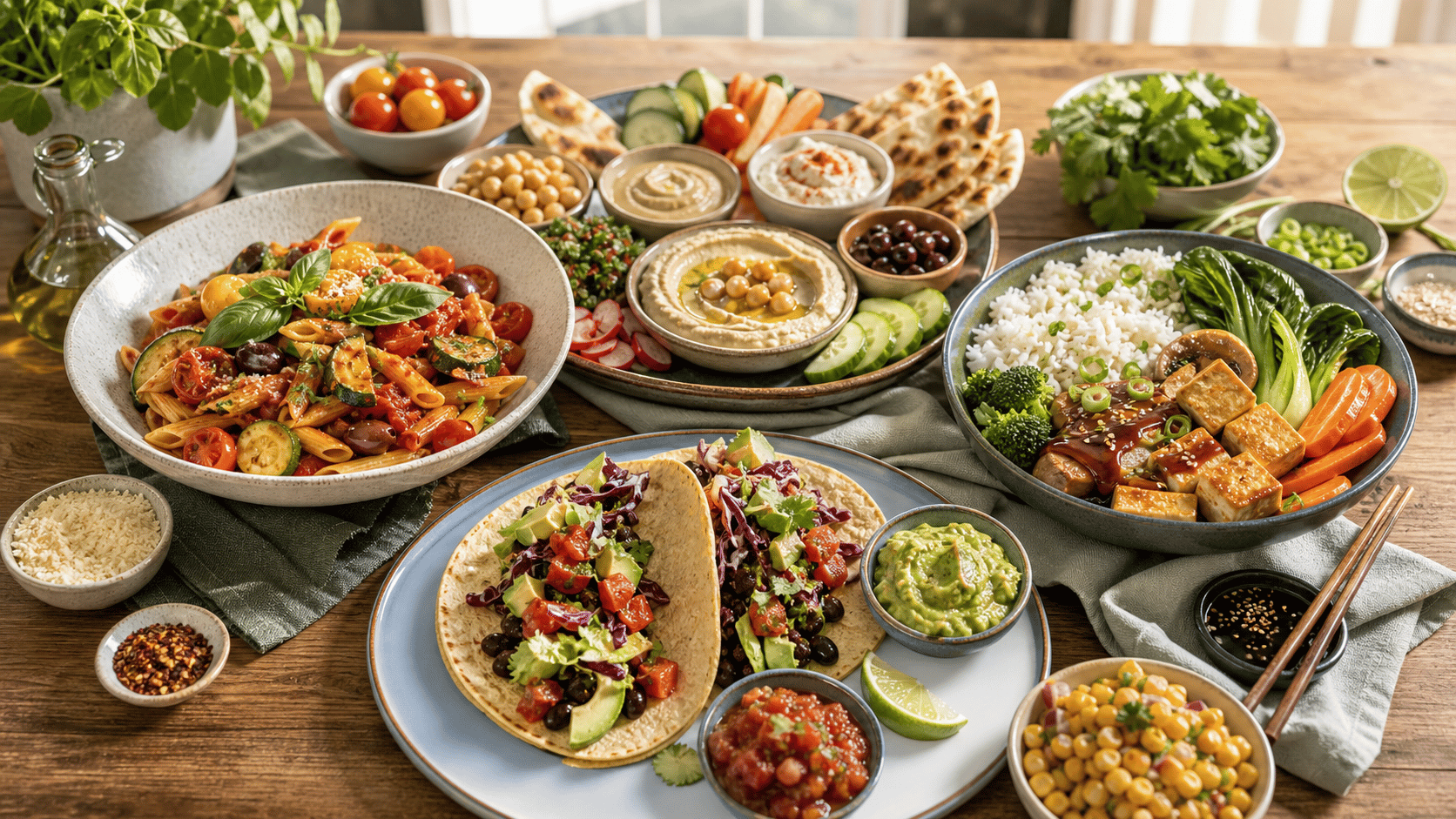
Adapting a world cuisine starts by breaking the dish into parts: sauce, seasoning, starch, protein, coating, and toppings. The dish name is not enough because allergens can appear in marinades, dusting flour, shared fryer oil, or a garnish added at the end.
In a restaurant or when hosting, the best question is not only whether something is gluten-free or dairy-free. Ask how it is prepared, which sauce is used, whether equipment is shared, and whether toppings can be left off. If the answer is uncertain, choose a simpler dish.
At home, begin with a basic version and add layers later. This makes it easier to see which ingredient is the problem and which substitute is actually needed.
Checklist
- ✓ Break the dish into sauce, base, protein, and toppings.
- ✓ Check sauces and spice blends.
- ✓ Ask about oil, surfaces, and shared equipment.
- ✓ Start simple before making complex adaptations.
The serving-time decision test
A good decision shows up at serving time: it is clear what was prepared, who it fits, which ingredients were checked, and which risks remain unknown. If that cannot be explained in one short sentence, simplify before serving.
Safer cooking does not require a complicated menu. A simple dish with clear ingredients is often better than an impressive dish with an unclear sauce, unchecked spice mix, or shared serving tool.
When hosting, write down what is allowed and what is not before the meal begins. That helps the guest, the family, and the person who serves the food.
| Before serving | Short question | Action |
|---|---|---|
| Ingredients | Was everything checked? | Replace unclear ingredients |
| Tools | Was anything shared? | Use a clean separate utensil |
| Guests | Was the need explained? | Use one clear sentence before the meal |
Everyday life implications
In daily life, users need repeatable routines more than long warnings. The best page gives them a small set of decisions: identify the restriction, read the label, choose a clean preparation path, communicate with hosts or schools, and store the result clearly. That routine works whether the topic is dairy-free cooking, soy and sesame, cross-contact, food labels, or world cuisine adaptation.
Families also need language that can be repeated by grandparents, babysitters, teachers, and friends. Instead of saying “it is allergy-safe,” say what was checked: no milk ingredients on the label, prepared with clean utensils, no shared nut toppings, or oats labeled gluten-free. Specific wording reduces confusion.
For Hebrew-first families, mixed-language instructions can create mistakes. Ingredient names, warnings, steps, and notes should be readable in the language the family is using. If a translation is not ready, it is safer to say so clearly than to switch language silently.
Checklist
- ✓ Name the exact restriction before choosing a recipe.
- ✓ Check package labels and allergen statements, not only the ingredient headline.
- ✓ Use clean preparation tools and serving tools.
- ✓ Keep school, host, and family instructions short and repeatable.
- ✓ Avoid broad promises; explain what was checked.
| Dining situation | Risk | Practical choice |
|---|---|---|
| New restaurant | Unknown workflow | Call outside rush hours |
| Travel meal | Language and ingredient gaps | Carry translated restriction card |
| Shared mezze/table dishes | Serving spoons move between plates | Serve individual portions |
| Bakery or dessert shop | Nuts, dairy, gluten, sesame common | Ask about facility and display case |
Real-life scenarios
These scenarios turn information into decisions. Instead of memorizing many rules, check what is actually about to happen: shopping, school, restaurant dining, a holiday meal, hosting, or a family dinner.
When there is uncertainty, choose a simple action: a clearer product, a simpler dish, a cleaner tool, or one more precise question. That reduces mistakes without turning every meal into a stressful discussion.
Checklist
- ✓ Save label photos for regular products.
- ✓ Prepare a backup for school, trips, or holidays.
- ✓ Ask restaurants about sauce, oil, and prep tools.
- ✓ Serve restricted dishes first with clean utensils.
| Scenario | What can go wrong | What to do |
|---|---|---|
| Family meal | Spoons move between dishes or crumbs enter a jar | Serve the restricted dish first with a separate utensil |
| School | Homemade snack conflicts with policy or lacks ingredients | Keep a backup snack with a clear label |
| Shopping | Front label sounds helpful but the full label is complex | Read ingredients, allergen statements, and warnings before buying |
| Restaurant | Sauce, fryer oil, or shared surfaces are not checked | Ask about preparation, not only the dish name |
| Holiday | Many dishes and serving tools get mixed | Label the adapted dish and keep it covered until serving |
| Hosting guests | Host guesses from broad terms | Send the exact ingredients to avoid before shopping begins |
Cooking implications
Cooking implications begin with function. Colorado State University Extension – Ingredient Substitutions supports a substitution mindset: ingredients do jobs. Milk can add liquid, protein, browning, flavor, or tenderness. Butter can add fat, aeration, structure, and flavor. Eggs can bind, emulsify, leaven, and add moisture. Wheat flour can provide structure and elasticity. Nuts can add fat, crunch, protein, and flavor.
When adapting a recipe, the question is not only “what can I remove?” but “what job did it perform?” A soy-free sauce may need salt, umami, and liquid. A sesame-free dip may need body and roasted flavor. A nut-free cookie may need fat and texture. A pareve dessert after a meat meal may need dairy-free structure without implying allergy safety.
Every replacement must be checked for its own allergens. Almond milk may solve dairy but fail nut-free. Soy milk may solve dairy but fail soy-free. Oat milk may solve dairy but need gluten-free labeling for celiac-aware cooking. Coconut may be useful for texture but still needs personal suitability and label review.
Do
- ✓ Choose substitutes by recipe function.
- ✓ Check whether the substitute introduces nuts, soy, sesame, gluten, egg, or dairy.
- ✓ Test texture before serving to guests.
- ✓ Link the recipe back to the relevant guide.
Don't
- • Do not treat vegan, pareve, or gluten-free as a full allergy review.
- • Do not recommend one universal substitute for every recipe.
- • Do not remove an ingredient without replacing its structure when structure matters.
Common mistakes
The first common mistake is stopping at labels. A label like dairy-free, vegan, pareve, or gluten-free sounds clear, but it does not explain ingredients, preparation, cross-contact, or the person’s specific need.
The second mistake is overusing broad safety words. A recipe can be dairy-free and still contain nuts. A dish can be pareve and still contain sesame. A gluten-free recipe can still be unsafe for a person with celiac disease if prepared with shared tools. A world cuisine page can inspire adaptation, but it still needs ingredient checks.
The third mistake is hiding uncertainty. Good guidance says when a label must be checked, when a professional should be consulted, when a recipe has not been reviewed, and when a substitute affects texture.
Safety considerations
Safety considerations should remain practical and humble. No public guide can know every manufacturing line, school policy, kitchen history, restaurant fryer, or child’s individual medical plan. What it can do is teach readers how to reduce avoidable risk.
Good decisions combine food-allergy logic from FDA – Food Allergies, local label-reading context from Israel Ministry of Health – Food Allergen Guidance, and cooking substitution logic from Colorado State University Extension – Ingredient Substitutions when those sources are relevant. None of these creates medical certainty, but together they help reduce avoidable mistakes.
If a recipe has not passed translation, allergy, kosher, legal, or human review, the wording should stay modest and specific.
Troubleshooting
If a reader feels lost, the next step needs to be clearer: read a focused explanation, browse related recipes, review labels, or use a substitution table. A family should not have to guess where to go next.
If users see mixed-language content, translation readiness is the problem. Do not silently fallback from Hebrew UI to English recipe instructions. Show a clear translation status or keep the content out of the public path until the required fields exist.
If a substitution fails, troubleshoot the function. Did the recipe lose fat, liquid, structure, binding, browning, or flavor? Did the replacement introduce a new allergen? Did the package label change? Did cross-contact happen through tools or storage?
| Problem | Likely cause | Safer next step |
|---|---|---|
| Staff says 'probably fine' | No verified process | Choose another dish or restaurant |
| Menu has symbols only | Symbols may not cover all allergens | Ask for ingredient confirmation |
| Dish arrives with garnish | Kitchen missed instruction | Do not scrape it off; ask for a new plate if appropriate |
FAQ
What is the first step?
Start by naming the exact restriction, then check labels before choosing a recipe or substitute.
Is a general label enough for safety?
No. Labels such as vegan, pareve, or gluten-free do not replace ingredient and cross-contact checks.
How do I choose a substitute?
Choose by recipe function: liquid, fat, structure, binding, flavor, or browning, then check new allergens.
When do I need professional guidance?
For children, severe allergy, celiac disease, new symptoms, or unclear labels, use professional guidance.