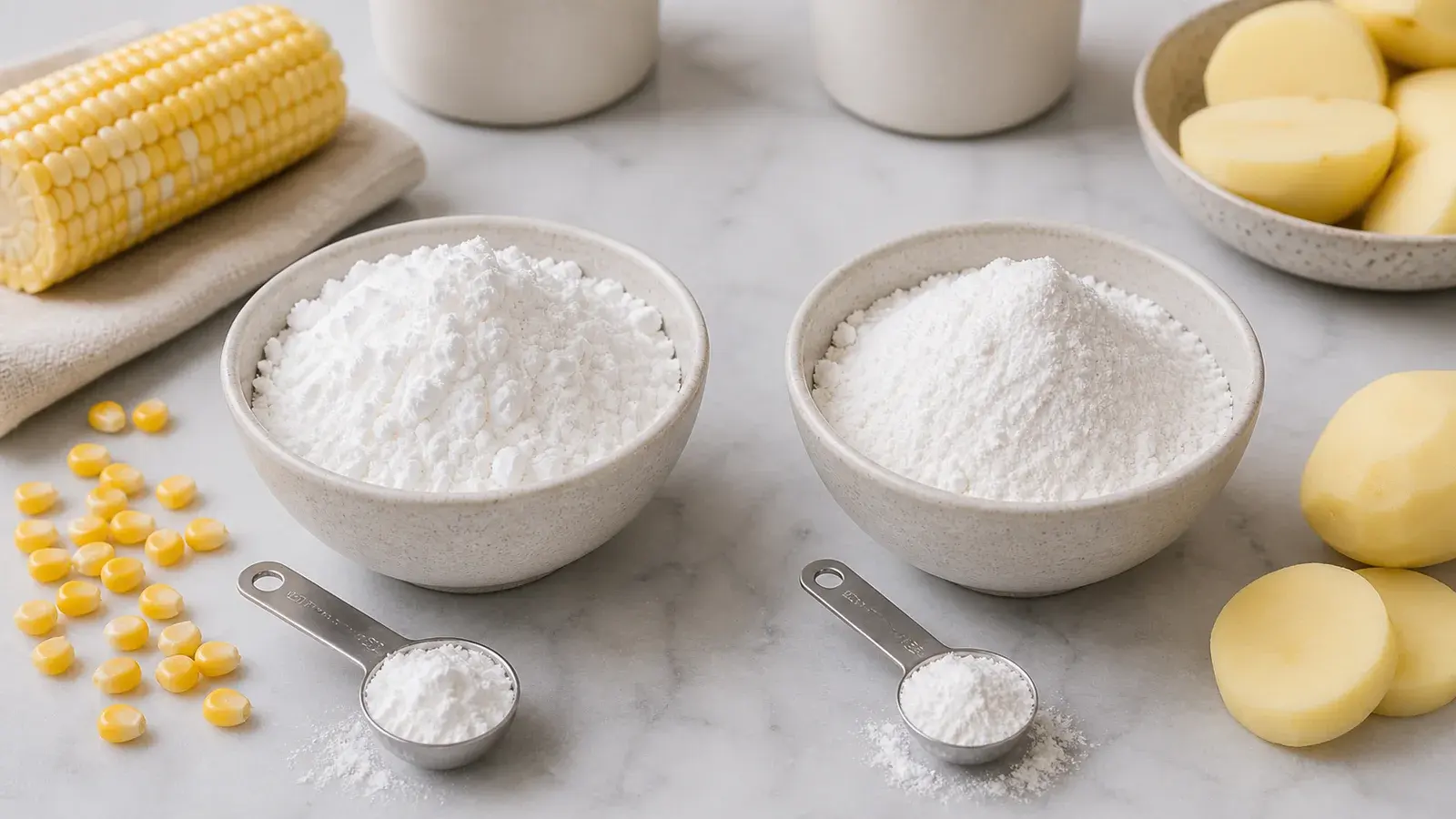
cornstarch vs potato starch
Cornstarch vs Potato Starch: Differences in Cooking and Baking
Cornstarch vs potato starch — key differences in thickening, baking, and frying. Learn which to use for sauces, gravies, cakes, and crispy coatings.
Both cornstarch and potato starch are fine white powders used to thicken sauces and lighten baked goods — but they're not identical, and the differences matter. One handles heat better; the other survives freezing without breaking down. One produces a crispy fried coating; the other gives baked goods a particularly soft crumb. Here's exactly how they compare and when to use each.
Quick Comparison
| Property | Cornstarch | Potato Starch |
|---|---|---|
| Source | Corn (maize) kernels | Potato tubers |
| Thickening power | Moderate | Higher |
| Clarity when thickened | Slightly cloudy | Clear, glossy |
| Heat tolerance | Breaks down at very high heat | Breaks down at very high heat too |
| Freeze-thaw stability | Poor — becomes watery | Better |
| Best use | Sauces, baking, coatings | Sauces, GF baking, coatings |
| Corn allergy safe | No | Yes |
What Is Cornstarch?
Cornstarch (called cornflour in the UK) is the starch extracted from the endosperm of corn kernels. It's the most commonly used thickener in American and Western European cooking. A tablespoon or two of cornstarch slurry transforms thin pan juices into a glossy, rich sauce.
In baking, replacing a small portion of all-purpose flour with cornstarch is an old trick for making cakes more tender — the starch dilutes the protein content, resulting in a softer, finer crumb. In GF baking, it plays the same role within flour blends.
Cornstarch produces a slightly opaque finish when used as a thickener. It works best in sauces that will be served immediately — it holds thickening well at serving temperature but can become gloopy if refrigerated and reheated repeatedly.
Popular brands: Argo Corn Starch, Bob's Red Mill Cornstarch, Clabber Girl
Best uses:
- Thickening stir-fry sauces and gravies
- Lightening the crumb in cakes ("tender crumb trick")
- Crispy fried chicken or tofu coating
- Puddings and pastry cream
Thickening ratio
- 1 tablespoon cornstarch thickens approximately 1 cup of liquid to a medium-thick consistency
- Make a slurry: mix with equal parts cold water before adding to hot liquid
What Is Potato Starch?
Potato starch is extracted from raw potatoes: the starch is washed out, then dried into a very fine, bright-white powder. It should not be confused with potato flour (made from whole dried potatoes — very different properties, much stronger flavor).
Potato starch has a slightly higher thickening power than cornstarch, produces a clearer, more glossy result, and — importantly — holds up better when a sauce is frozen and reheated. This makes it the better choice for make-ahead meals and freezer-friendly dishes.
In GF baking, potato starch's most valued property is its ability to create a soft, moist crumb. It absorbs moisture during baking and releases it slowly, keeping GF baked goods tender for longer. This is why it features in most commercial GF flour blends.
Popular brands: Bob's Red Mill Potato Starch, Anthony's Potato Starch, NOW Foods Potato Starch
Best uses:
- Thickening sauces and soups that will be frozen
- Adding softness to GF baked goods
- Korean and Chinese-style crispy fried coatings
- Thickening dairy-free gravies (more stable under reheating)
Thickening ratio
- Use slightly less potato starch than cornstarch: about ¾ tablespoon potato starch per 1 tablespoon cornstarch
- Or use equal amounts and expect a slightly thicker result
Frying: Which Makes a Crispier Coating?
Both starches are used in East Asian frying techniques, and both produce crispier results than wheat flour. For the crispiest coating:
- Potato starch (especially in Korean fried chicken) tends to produce a crunchier, more shatteringly crisp crust that stays crisp longer.
- Cornstarch is excellent for a lighter, thinner crunch — ideal for delicate items like shrimp or thin vegetable slices.
A blend of 50% potato starch + 50% rice flour is a popular GF coating that produces excellent crunch without becoming soggy.
Freezing Behavior
One area where the two starches diverge significantly: freeze-thaw stability. Cornstarch-thickened sauces often become watery or develop a starchy, separated texture after freezing and reheating. Potato starch handles this much better and is the preferred thickener for soups, stews, and gravies intended for the freezer.
⚠️ Safety Notes for Celiacs and Allergy Sufferers
- Corn allergy: Cornstarch is not safe for people with a corn allergy. Use potato starch, arrowroot, or tapioca starch as replacements.
- Both cornstarch and potato starch are naturally gluten-free, but cross-contamination during manufacturing is possible. Always choose products with a certified gluten-free label if you have celiac disease.
- Potato allergy: Though uncommon, some individuals react to potato. Those with nightshade sensitivity should use cornstarch, arrowroot, or tapioca instead.
- Bob's Red Mill certifies both their cornstarch and potato starch as gluten-free — a reliable brand for celiac households.
Where to Buy
- Amazon US: Shop potato starch and cornstarch on Amazon
- Amazon UK: Shop GF starches on Amazon UK
- iHerb: Browse potato starch on iHerb
Conclusion
For everyday sauce thickening and quick baking applications, cornstarch is convenient and widely available. Choose potato starch when you need freeze-thaw stability, a clearer glossy sauce, a crunchier fried coating, or a softer crumb in GF baking. If you have a corn allergy or want to avoid corn-derived products, potato starch is the straightforward, effective swap.
Frequently Asked Questions
Q: Can I substitute cornstarch with potato starch at a 1:1 ratio? Almost — potato starch has slightly higher thickening power. Start with ¾ tablespoon of potato starch per tablespoon of cornstarch to avoid over-thickening. In baking, the substitution is closer to 1:1 and the small difference in thickening power rarely matters.
Q: Which is better for making gravy — cornstarch or potato starch? Both work well for fresh gravy. If you're making gravy to freeze and reheat later, potato starch is the better choice — it maintains its consistency after freezing far better than cornstarch, which can become watery.
Q: Does cornstarch have gluten? Pure cornstarch is made from corn and is naturally gluten-free. However, it can be cross-contaminated in facilities that process wheat. For celiac disease, always choose a certified gluten-free cornstarch such as Argo or Bob's Red Mill.
Q: Can I use potato starch in place of cornstarch in a cake? Yes. Replace cornstarch with an equal amount of potato starch in cake recipes. Potato starch may produce an even softer, more moist crumb than cornstarch. The difference is subtle, but if you're avoiding corn, potato starch is an excellent swap.
Q: Why does my cornstarch sauce get watery after refrigerating? Cornstarch-thickened sauces can "retrograde" — the starch molecules realign when cooled, releasing water. To minimize this: don't over-thicken initially, reheat gently and stir, and if you plan to make ahead, switch to potato starch or arrowroot, which are more stable.