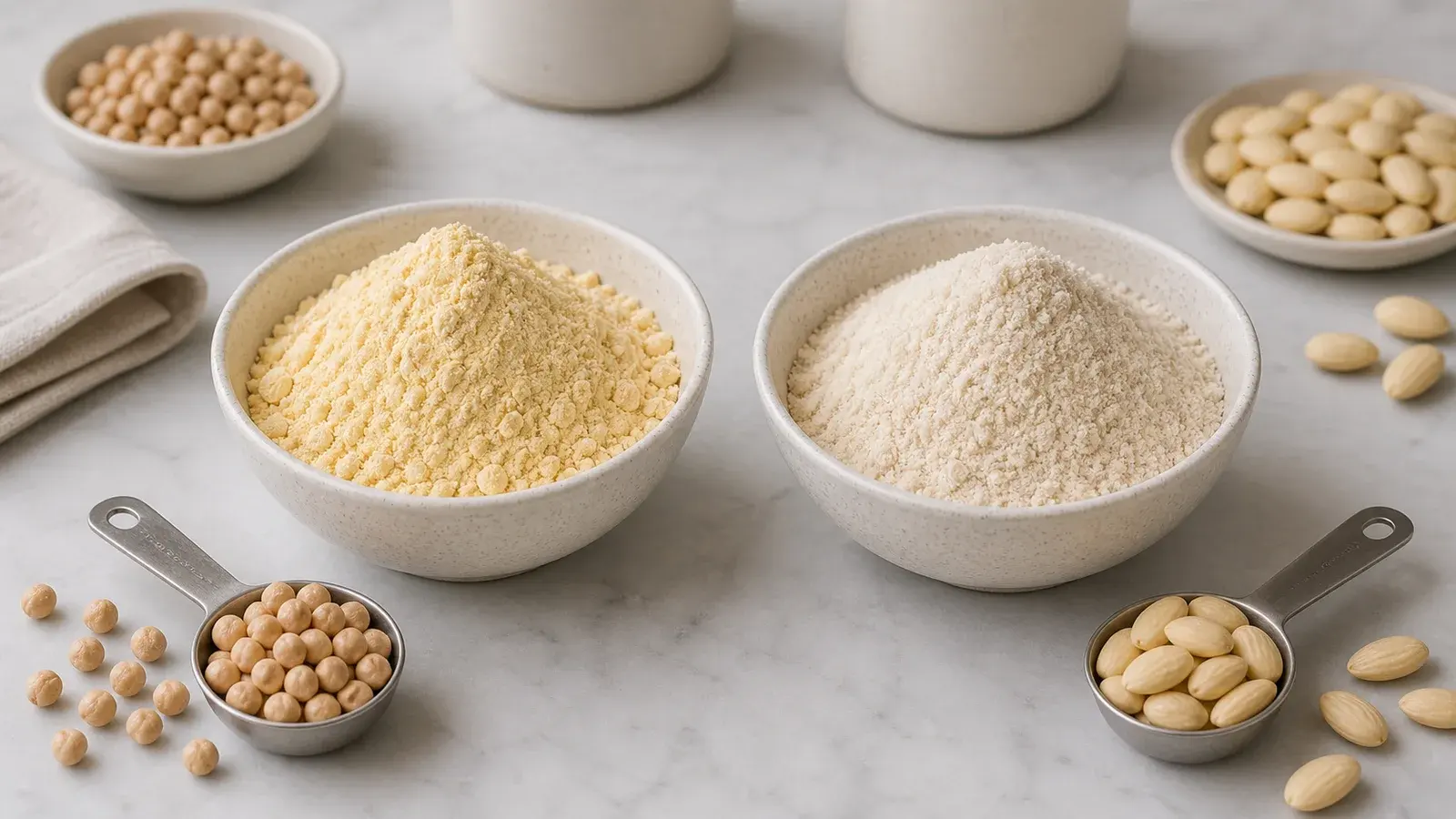
chickpea flour vs almond flour gluten free baking
Chickpea Flour vs Almond Flour: Full Comparison for GF Baking
Chickpea flour vs almond flour — full comparison for gluten-free baking. Flavor, protein, ratios, best uses, and safety notes for celiacs and allergy sufferers.
Both chickpea flour and almond flour are popular single-ingredient gluten-free flours that go far beyond just "avoiding wheat." Each brings distinct nutritional properties, flavors, and baking behaviors to the table. Knowing their strengths — and their quirks — helps you choose the right one for the recipe at hand, or decide when to blend them together.
Quick Comparison
| Property | Chickpea Flour | Almond Flour |
|---|---|---|
| Made from | Ground dried chickpeas | Blanched, ground almonds |
| Gluten-free | Yes | Yes |
| Protein per 100g | ~22g | ~21g |
| Fat per 100g | ~6g | ~50g |
| Fiber per 100g | ~11g | ~10g |
| Flavor | Earthy, slightly beany, savory | Mild, nutty, slightly sweet |
| Best for | Savory flatbreads, fritters, coatings | Cookies, cakes, sweet baking |
| Nut allergy safe | Yes (legume) | No (tree nut) |
What Is Chickpea Flour?
Chickpea flour — also called garbanzo bean flour, gram flour, or besan — is made by grinding dried chickpeas into a fine powder. It's a foundational ingredient in Indian, Middle Eastern, and Mediterranean cuisines, used for everything from pakoras and socca to falafel coatings and savory pancakes.
Chickpea flour has a robust, slightly earthy, mildly beany flavor that makes it assertive in baked goods. This flavor mellows when cooked and largely disappears when combined with strong spices or sweet ingredients, but in neutral applications it can be noticeable. It's higher in fiber and carbohydrates than almond flour and lower in fat.
Mixed with water, chickpea flour forms a batter that acts as a vegan egg substitute in savory recipes: 2–3 tablespoons chickpea flour + 3–4 tablespoons water ≈ 1 egg for binding.
Popular brands: Bob's Red Mill Garbanzo Bean Flour, Anthony's Organic Chickpea Flour, Swad Besan, Doves Farm Chickpea Flour (UK)
Best uses:
- Socca (Provençal chickpea flatbread) — one of the best uses
- Pakoras, bhajis, and fritters
- Falafel binding
- Pizza crust and savory pancakes
- Crispy coating for baked or fried vegetables
- Egg-free binding in savory bakes
What Is Almond Flour?
Almond flour is made from blanched almonds (skins removed) that are finely ground into a soft, pale, slightly oily powder. It's the dominant flour in paleo and grain-free baking and one of the most widely used single-ingredient GF flours in North American and European kitchens.
Its high fat content gives almond flour its signature quality in baking: natural moisture, a tender crumb, and mild nutty sweetness. These fats prevent baked goods from drying out. Almond flour substitutes all-purpose flour at roughly 1:1 by volume, but needs additional binding (eggs are ideal). It doesn't absorb liquid aggressively, making it one of the more forgiving GF flours.
Popular brands: Bob's Red Mill Super-Fine Almond Flour, Anthony's Almond Flour, Blue Diamond Almond Flour, Kirkland Signature
Best uses:
- Cookies (especially chocolate chip and shortbread)
- Almond cakes and financiers
- Muffins and quick breads
- Pancakes (light, moist texture)
- GF pizza crust (with egg for binding)
Key Differences in Baking
Flavor: Almond flour has a mild, sweet nuttiness that blends into most sweet recipes. Chickpea flour's assertive, earthy note pairs well with spices but can overwhelm delicate sweets.
Fat and moisture: Almond flour is significantly higher in fat (~50g per 100g vs ~6g). This means almond flour baked goods stay moist and tender much longer.
Structure: Chickpea flour creates a firmer, denser crumb — ideal for flatbreads and fritters. Almond flour gives a tender, cake-like crumb for cookies and cakes.
Savory vs sweet: Chickpea flour is primarily a savory flour; almond flour skews sweet. This is the simplest rule to remember.
Can You Blend Them?
A 50/50 blend works well for savory pancakes, pizza crust, and vegetable fritters — almond flour softens chickpea flour's beany note and adds moisture, while chickpea flour provides structure and protein.
⚠️ Safety Notes for Celiacs and Allergy Sufferers
- Tree nut allergy: Almond flour is made from almonds, a tree nut. It is not safe for anyone with a tree nut allergy. Chickpea flour is a legume and does not contain tree nuts.
- Legume allergy: Chickpea flour is made from legumes (chickpeas/garbanzo beans). Those with legume allergies, or those who react to peanuts (also a legume), should introduce chickpea flour cautiously and confirm tolerance with their allergist.
- Cross-contamination: Both flours are naturally gluten-free but can be cross-contaminated during processing in facilities that also handle wheat. For celiac disease, always choose certified gluten-free labeled products.
- Both flours are dairy-free, egg-free, and soy-free in their pure forms — broadly compatible with most common dietary restrictions.
- Chickpea flour can cause digestive discomfort (gas, bloating) in some people with IBS or FODMAP sensitivity, as chickpeas are a high-FODMAP food.
Where to Buy
- Amazon US: Shop chickpea flour and almond flour on Amazon
- Amazon UK: Shop GF flours on Amazon UK
- iHerb: Browse chickpea flour on iHerb
Conclusion
Choose chickpea flour for savory applications — flatbreads, fritters, coatings, and egg-free binding in savory recipes. Its earthy flavor and firm structure shine in these roles. Choose almond flour for sweet baking — cookies, cakes, muffins, and pancakes where a moist, tender crumb and mild flavor are desirable. If nut allergies are a concern in your household, chickpea flour is the nut-free GF alternative for most everyday baking needs.
Frequently Asked Questions
Q: Can I substitute almond flour with chickpea flour in a cookie recipe? Not without significant adjustments. Chickpea flour has a strong earthy, beany flavor that will dominate a sweet cookie recipe. It also behaves differently — it's less fatty and creates a firmer, denser texture. For sweet baking, almond flour is the better choice; chickpea flour is best reserved for savory applications or heavily spiced recipes.
Q: Is chickpea flour higher in protein than almond flour? They're very close — both contain roughly 21–22g per 100g. The protein types differ (tree-nut vs legume), but both are solid protein sources for a gluten-free diet.
Q: Does chickpea flour taste like beans? Raw chickpea flour has a distinct earthy, beany note. When cooked — especially roasted or in a crispy coating — this flavor mellows considerably and develops into something nutty and savory. It largely disappears when paired with strong spices like cumin, coriander, turmeric, or garlic.
Q: Is chickpea flour (besan) gluten-free? Yes, chickpeas are naturally gluten-free. However, in countries like India, besan is sometimes milled in facilities that also handle wheat flour, creating a real cross-contamination risk. If you have celiac disease, choose a product specifically labeled as certified gluten-free, particularly when buying from brands that also produce wheat products.
Q: Can I use almond flour to make socca (chickpea flatbread)? Socca is specifically made with chickpea flour — its distinctive flavor and firm-yet-creamy texture come from chickpea flour's unique protein-starch balance. Substituting almond flour will give you a completely different product: fattier, softer, and without the characteristic flavor. For authentic socca, chickpea flour is non-negotiable.